

A wellness routine is defined as a personalised set of consistent daily habits designed to improve your physical and mental health over time. Unlike a single diet or fitness plan, a wellness lifestyle integrates multiple practices, including sleep, nutrition, movement, and stress management, into a coherent daily structure. The World Health Organization recognises evidence-based self-help as a core pillar of sustainable wellbeing, which means your routine does not need to be complex to be effective. What it does need is intention, consistency, and a design that fits your actual life.
What is a wellness routine and what does it actually include?
A wellness routine is the deliberate practice of stacking health-supporting behaviours into your day so they become automatic rather than effortful. The goal is not perfection. The goal is a repeatable structure that protects your energy, mood, and physical health across weeks and months, not just days.
The core wellness priorities that research consistently identifies include:
- Sleep quality. Seven to nine hours of restorative sleep regulates cortisol, appetite hormones, and cognitive function. Poor sleep undermines every other element of your routine.
- Nutrition and hydration. A nourishing diet built around whole foods, adequate protein, and consistent water intake provides the biological foundation for energy and mood stability.
- Physical movement. This does not require a gym membership. A 30-minute walk, a yoga session, or a strength training circuit all count. Consistency matters far more than intensity.
- Mental health practices. Mindfulness, journalling, breathwork, and psychological self-help techniques reduce stress load and improve emotional regulation.
- Social connection. Regular, meaningful contact with others is a protective health factor that many adults in the 30 to 55 age group deprioritise under pressure of work and caregiving.
- Rest and recovery. Scheduled downtime, including screen-free evenings and rest days from exercise, is not laziness. It is a physiological requirement.
The most common mistake people make when building a wellness routine is trying to address all six areas simultaneously from day one. Research from the Stanford Design Lab shows that tiny habits stick better than sweeping overhauls. This means choosing two or three non-negotiables first and building outward from there.
Pro Tip: Pick one morning and one evening anchor habit before adding anything else. A glass of water upon waking and five minutes of reading before sleep are low-effort, high-return starting points.

How does wellness stacking improve habit formation?
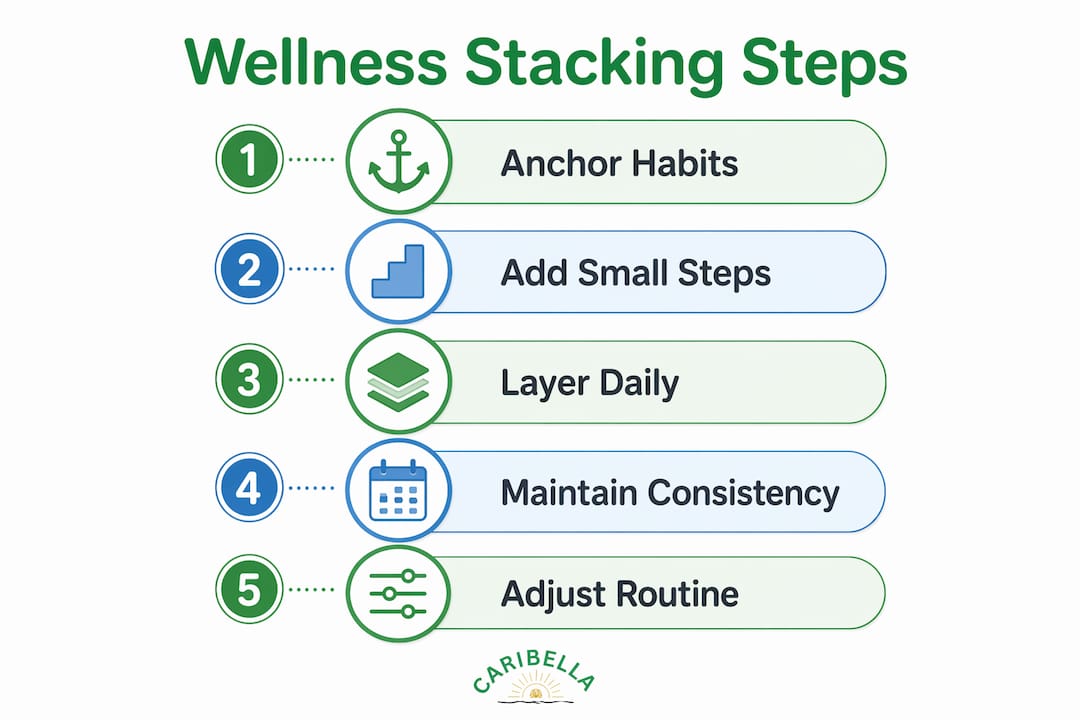
Wellness stacking is defined as the intentional layering of complementary health behaviours around an existing daily anchor. Psychologists describe it as one of the most underused strategies for building lasting routines, particularly for adults managing high cognitive loads at work and at home.
The mechanism is straightforward. Your brain treats a well-established behaviour, such as making your morning coffee, as a reliable trigger. When you attach a new wellness action to that trigger, the new behaviour borrows the neural momentum of the existing one. Over time, the stack becomes the habit rather than any individual behaviour within it. This is a meaningful shift in how you think about routine-building.
Here is a practical example of a morning wellness stack built around a coffee anchor:
- Wake up and drink a full glass of water before touching your phone.
- Make your coffee or herbal tea while taking five slow, deliberate breaths.
- Spend ten minutes moving, whether that is stretching, a short walk, or bodyweight exercises.
- Eat a protein-rich breakfast before sitting down to work.
- Write three priorities for the day in a notebook, not a screen.
Each step takes less than five minutes individually. Together, they create a 25 to 30 minute morning structure that addresses hydration, movement, nutrition, and mental clarity in one go. Practitioners recommend attaching new habits to existing anchors like brushing teeth or making coffee precisely because it removes the need for motivation each morning.
Wellness stacking is particularly effective for people managing anxiety or chronic stress. Experts note that reduced cognitive load from a predictable sequence creates a sense of control that itself reduces stress. For adults aged 30 to 55 who are often juggling career demands, family responsibilities, and health concerns simultaneously, this is not a minor benefit.
Pro Tip: If your stack breaks for a day or two, do not restart from scratch. Re-enter at the easiest step in the sequence. Momentum is easier to rebuild from the middle than from zero.
Why should your wellness routine adapt across life phases?
A wellness routine that worked at 32 will not necessarily serve you at 45 or 52. The WHO’s life-course health framework establishes that health outcomes are shaped by protective and risk factors that shift across life transitions, including career changes, parenthood, perimenopause, and retirement. A one-size-fits-all plan ignores this reality entirely.
For adults in the 30 to 55 age range, the most common transition points that demand routine adjustment include hormonal shifts, increased caregiving responsibilities, and changes in sleep architecture. Understanding how to balance hormones naturally in midlife, for example, often requires adding specific nutritional support and adjusting exercise intensity rather than simply doing more of the same.
| Life phase | Common wellness challenge | Routine adjustment |
|---|---|---|
| Early 30s | High work stress, irregular sleep | Prioritise sleep hygiene and stress management practices |
| Mid 30s to 40s | Caregiving demands, reduced personal time | Shorten routines; focus on non-negotiable daily minimums |
| Perimenopause (40s to early 50s) | Hormonal fluctuation, disrupted sleep, mood changes | Add targeted nutrition, herbal support, and recovery-focused movement |
| Mid 50s | Metabolic changes, joint health, energy management | Shift to lower-impact movement, increase protein intake, prioritise rest |
The life-course framing makes one thing clear: your routine is not a fixed document. It is a living practice that should be reviewed and adjusted at least once a year, or whenever a significant life change occurs. If your current routine feels like it belongs to a previous version of you, it probably does.
What practical steps build a sustainable wellness routine?
Building a wellness routine that lasts requires a self-assessment before any habit selection. You need to know where your energy is currently going, which health areas are most depleted, and what your realistic daily time budget actually is. Skipping this step is why most routines collapse within three weeks.
Once you have a clear picture of your starting point, the following approach works consistently:
- Set two to three non-negotiables. These are the habits you commit to regardless of how busy the day becomes. Sleep before midnight, a ten-minute walk, and one nutritious meal are examples that require minimal time but deliver consistent returns.
- Use weekly rhythms, not daily rigidity. Aiming for five out of seven days on any given habit is more sustainable than demanding perfection every day. Tracking key metrics like sleep quality, stress levels, and movement frequency helps you stay honest without becoming obsessive.
- Make it enjoyable. Pair movement with a podcast you only listen to during exercise. Drink a tea you genuinely love as part of your wind-down routine. Pleasure is not a luxury in habit design. It is a retention mechanism.
- Build in social accountability. Sharing a wellness goal with a friend, joining a class, or working with a coach at a platform like HollyFit increases follow-through significantly. Accountability is one of the most underrated components of a wellness routine.
- Plan for setbacks explicitly. Decide in advance what you will do when you miss a day, travel, or fall ill. Having a written “minimum viable routine” for difficult weeks prevents complete abandonment.
The wellness terminology around habit formation can feel overwhelming at first. The practical reality is simpler: start with what you can do today, not what you aspire to do eventually.
Pro Tip: Review your routine every 90 days. Ask yourself which habits are producing results, which feel like chores, and which you have quietly dropped. Honest quarterly reviews prevent routine drift.
Key takeaways
A sustainable wellness routine is built through consistent, personalised daily practices that adapt across life phases rather than following a fixed, one-size-fits-all plan.
| Point | Details |
|---|---|
| Define your non-negotiables | Choose two to three daily habits first and build outward only once they are stable. |
| Use wellness stacking | Attach new health behaviours to existing anchors to reduce decision fatigue and build momentum. |
| Adapt across life phases | Review and adjust your routine at major life transitions, particularly during hormonal and lifestyle shifts in your 40s and 50s. |
| Track without obsessing | Monitor sleep, stress, movement, and nutrition at a high level to maintain focus and spot gaps early. |
| Prioritise enjoyment | Routines that include activities you genuinely like are retained far longer than those built purely on discipline. |
Why simplicity is the most underrated wellness strategy
Most people I speak with who have struggled to maintain a wellness routine share one common pattern: they designed a routine for their best possible day rather than their average one. They planned for eight hours of sleep, a 45-minute workout, a home-cooked breakfast, and a 20-minute meditation. Then life intervened, and the whole structure collapsed because it had no tolerance for reality.
What actually works, in my experience, is designing around your worst realistic day first. If you can do your minimum routine when you are tired, stressed, and short on time, you will do it consistently. The days when you have more capacity, you can add to it. But the foundation has to hold under pressure.
I have also seen people abandon genuinely good routines because they missed a few days and decided the whole thing had failed. Wellness stacking helps here precisely because re-entering a sequence at step two or three feels far less daunting than restarting from scratch. The stack gives you a re-entry point, not just a starting line.
The other thing worth saying plainly: your routine does not need to look like anyone else’s. A 55-year-old woman managing perimenopause and a 34-year-old man in a high-pressure job need entirely different structures. The components of a wellness routine are universal. The specific design is always personal.
— Nicole
How Caribella supports your daily wellness routine

Caribella’s plant-based products are designed to slot directly into the kind of daily wellness practices described in this article. The sea moss gels provide a nutrient-dense addition to morning routines, supporting energy, digestion, and immunity with minimal preparation. The herbal tea range pairs naturally with evening wind-down stacks, offering blends formulated for sleep support and stress relief. For women navigating hormonal shifts in their 40s and 50s, the Women’s Wellness Capsules offer targeted botanical support. If you are building a routine from scratch, the wellness bundles bring these products together in one place, making it straightforward to start.
FAQ
What is a wellness routine in simple terms?
A wellness routine is a personalised set of daily habits covering sleep, nutrition, movement, and mental health that you practise consistently to improve your overall wellbeing. The goal is sustainable health improvement, not short-term results.
How long does it take to build a wellness routine?
Research from the Stanford Design Lab suggests that small, consistent habits form more reliably than large behavioural overhauls, with most habits stabilising after several weeks of consistent repetition. Starting with two or three non-negotiables speeds up the process considerably.
What are the most important components of a wellness routine?
The core components are sleep quality, nutrition, physical movement, stress management, and social connection. The WHO also identifies evidence-based psychological self-help as a foundational wellness element for adults.
Does a wellness routine need to change as you get older?
Yes. The WHO’s life-course health approach confirms that health needs shift across life transitions, meaning routines should be reviewed and adjusted at major life changes, particularly during midlife hormonal shifts and changes in energy or sleep patterns.
What is wellness stacking and why does it work?
Wellness stacking is the practice of layering complementary health behaviours around an existing daily anchor, such as your morning coffee or teeth-brushing routine. Psychologists note that the stack becomes the habit, reducing the motivation and decision-making required to maintain each individual behaviour.