

Taking capsules sounds simple until it isn’t. If you’ve ever gagged trying to swallow a supplement, wondered whether you can open a capsule, or questioned whether a product is still safe to take, you’re not alone. Learning how to use capsules safely matters more as you get older, particularly if you’re navigating perimenopause or menopause, when your supplement routine can become more complex and the stakes of getting it wrong feel higher. This guide covers what you need to know: the types of capsules, how to swallow them comfortably, how to store them, and when to seek professional advice.
Table of Contents
- Key takeaways
- Understanding capsule types and safety
- Preparing to take capsules safely
- How to swallow capsules safely
- Storing and handling capsules correctly
- Modifying capsules: when and how
- My take on capsule safety after years working with women over 40
- Supporting your wellness with Caribella
- FAQ
Key takeaways
| Point | Details |
|---|---|
| Know your capsule type | Hard gelatin, softgel, and extended-release capsules each have different safety rules and handling requirements. |
| Always read the label | Capsule dosage instructions tell you timing, food requirements, and whether opening or splitting is permitted. |
| Posture matters when swallowing | A slight chin tuck is safer than tilting your head back, which opens the airway and raises choking risk. |
| Store capsules correctly | Keep capsules in a cool, dry place and avoid unnecessary refrigeration, which can cause condensation and shell degradation. |
| Consult before modifying | Never open, split, or crush a capsule without checking with your pharmacist or doctor first. |
Understanding capsule types and safety
Not all capsules are the same, and that distinction matters when you’re thinking about safely taking capsules. The three main types you’ll encounter are hard gelatin capsules, softgels, and extended-release or delayed-release formulations.
Hard gelatin capsules are the two-piece shells most commonly used for powdered supplements like sea moss or herbal blends. Softgels are sealed and typically contain oil-based contents such as omega-3s or vitamin D. Extended-release capsules are engineered to dissolve at a specific rate or in a specific part of the digestive tract.
That last category requires extra caution. Extended-release capsules must remain intact because damaging the shell destroys the release mechanism entirely, which can cause a harmful dose spike or complete treatment failure. This applies to certain prescription and over-the-counter products alike.
For women over 40, product quality is another layer of concern. The supplement industry is less regulated than pharmaceuticals, which means not every product on the shelf meets consistent quality standards. Choosing brands that are transparent about their ingredients and manufacturing processes is worth the extra effort.
Knowing the red flags of a compromised capsule is one of the best practices for capsule use you can adopt. Watch for:
- A rancid or unusual smell, particularly with oil-based capsules
- Leaking or oily residue on the outside of the capsule
- Sticky or deformed shells
- Changes in colour or clarity of the capsule contents
If you notice any of these signs, stop use immediately and consult a pharmacist. These are not minor cosmetic issues. They indicate that the product may be oxidised, contaminated, or otherwise unsafe.
Pro Tip: When selecting supplements, look for products with third-party testing certification or clear ingredient sourcing. Caribella’s sea moss capsules, for instance, are formulated with traceable natural ingredients, which takes much of the guesswork out of quality assessment.
Preparing to take capsules safely
Before you swallow your first capsule of any new supplement, a short preparation phase can prevent a lot of problems. This is especially true if you are perimenopausal or menopausal and already taking prescribed medications.
The most critical step is speaking to your GP or a qualified pharmacist before starting or changing any supplement regimen. Certain supplements interact with medications commonly used during midlife, including thyroid medications, blood thinners, and hormone therapies. Supplement timing relative to meals and other medications also affects how well they work, with some requiring food and others an empty stomach.
Reading the label thoroughly is not optional. Capsule dosage instructions tell you far more than just how many to take. They also tell you:
- The correct time of day to take the capsule
- Whether food is required or should be avoided
- Any contraindications with common medications or conditions
- Whether the capsule shell may be opened or the contents dispersed
If anything on the label is unclear, your pharmacist is your best resource. They can also confirm whether any of your current medications interact with a new supplement, which is particularly relevant for women over 40 who may be following a herbal supplement routine alongside prescribed treatments.
“Patients and carers must not alter medication forms without prescriber authorisation; safe administration instructions must be formalised to avoid errors.” — NHS SPS guidance on capsule modification
This applies equally to supplements. Just because a product is natural does not mean modifying it is without risk.
How to swallow capsules safely
Swallowing pills incorrectly can cause gagging, choking, skipped doses, and reduced effectiveness of treatment. It’s a more common issue than most people admit, and there are well-evidenced techniques that actually help.

The most widespread mistake is tilting your head back. It feels instinctive, but it is counterproductive. Tilting the head back opens the airway rather than the oesophagus, which raises the risk of choking. The correct posture is to sit upright and use a gentle chin tuck — slightly lowering your chin toward your chest as you swallow.
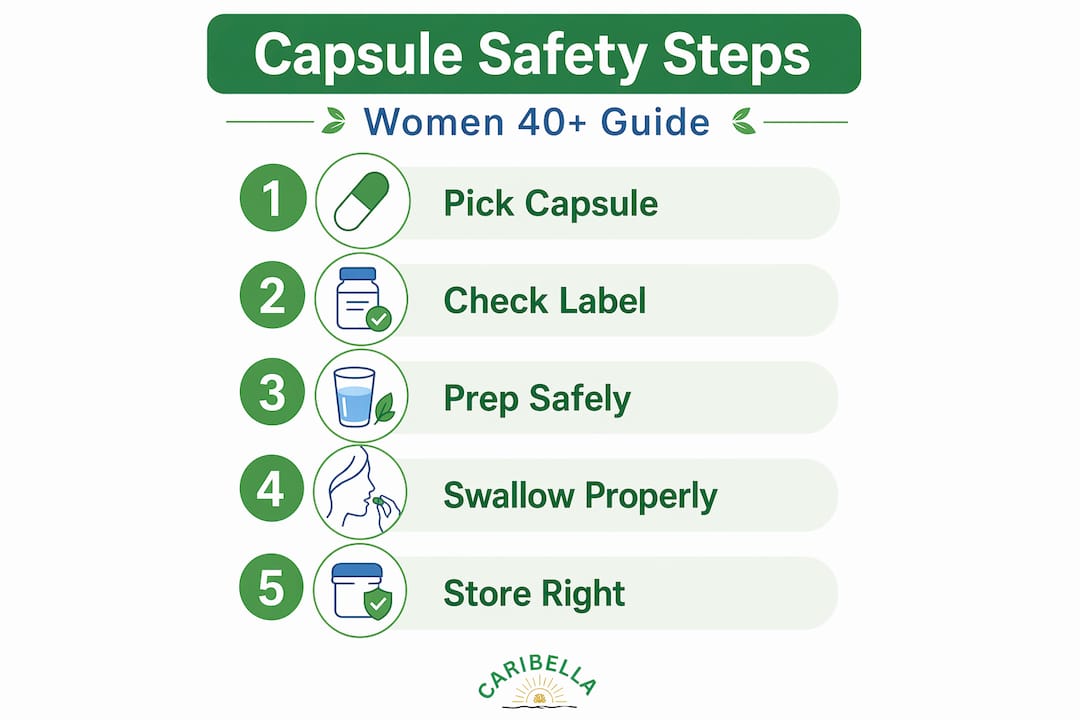
Here is a step-by-step method for how to swallow capsules safely:
- Sit upright with your back straight before you begin.
- Take a few sips of water to moisten your mouth and throat.
- Place the capsule on the middle of your tongue.
- Take a large sip of water but do not swallow yet.
- Tuck your chin slightly and swallow in one motion.
- Drink another full glass of water to help the capsule travel down comfortably.
If the standard method still causes difficulty, try the straw technique. Using a straw activates the natural swallowing reflex more effectively for many adults, making it easier to get the capsule down without gagging. Place the capsule on your tongue, seal your lips around the straw, and take a strong sip of water to carry it down.
Pro Tip: For softgel capsules specifically, some people find that placing them in a small amount of cold water for 30 seconds softens the outer shell slightly, making them easier to swallow. Do not do this with extended-release capsules.
Chewing a capsule is never a good option unless a healthcare provider has explicitly told you it is safe for that specific product. And if swallowing remains genuinely difficult over time, speak to your doctor. Swallowing difficulties can sometimes signal an underlying condition worth investigating.
Storing and handling capsules correctly
Good capsules safety guidelines extend well beyond the moment of swallowing. How you store your supplements directly affects their potency, safety, and shelf life.
| Storage condition | Correct approach |
|---|---|
| Temperature | Room temperature, ideally between 15°C and 25°C |
| Humidity | Low humidity; avoid bathrooms and kitchen windowsills |
| Light exposure | Away from direct sunlight; keep in opaque or amber containers |
| Refrigeration | Only if the label explicitly instructs it |
| Container use | Original packaging until the expiry date |
Refrigeration is worth addressing specifically. It feels like a logical way to extend product life, but unnecessary refrigeration of oil-based capsules causes condensation inside the container, which leads to shell degradation and reduced potency. Only refrigerate capsules if the product label tells you to.
Opening the bottle frequently and in varying temperatures also causes problems. Temperature fluctuations and repeated opening create condensation inside the bottle, sticking capsules together and accelerating spoilage.
Child safety is a separate but serious consideration. Keep all supplements, regardless of how natural they are, out of reach of children and stored in child-resistant containers. If accidental ingestion occurs, symptoms requiring emergency attention include collapse, seizures, breathing difficulty, and unconsciousness. Contact the NHS 111 service or Poison Control promptly for guidance, even if no symptoms are immediately apparent.
Modifying capsules: when and how
There will be times when swallowing a capsule intact is not possible, whether due to a medical condition, severe swallowing difficulty, or a requirement to mix contents with food or liquid. The rules here are clear.
Do not open, split, or modify any capsule without first speaking to your pharmacist or GP. Professional consultation before any capsule modification is non-negotiable because of the risks of dose inaccuracy, contamination, and loss of product stability.
If your healthcare provider confirms it is safe to open a specific capsule, follow this process:
- Wash your hands thoroughly before handling the contents.
- Open the capsule directly over the food or liquid you intend to use.
- Mix with 10 to 20ml of water or a soft food such as yoghurt or apple purée, as directed.
- Take the mixture immediately. Do not store it for later.
- Rinse the container or spoon and swallow the rinse to capture any remaining contents.
If modifying the capsule is regularly needed, ask about alternative formats. Many supplements, including some of Caribella’s wellness products, are available in formats that suit different needs. Powders, liquids, and dissolving supplements can offer the same nutritional benefits without the swallowing challenge.
| Format | Best suited for | Consideration |
|---|---|---|
| Standard capsule | Most adults | Follow label and posture guidance |
| Opened capsule contents | Per professional direction only | Use immediately; do not store |
| Powder supplement | Those with swallowing difficulty | Check dosage equivalence carefully |
| Liquid supplement | Post-surgery or severe dysphagia | Confirm with healthcare provider |
My take on capsule safety after years working with women over 40
I’ve worked with a lot of women who feel embarrassed to admit they struggle with swallowing capsules. They skip doses, halve products without checking, or avoid supplements altogether because nobody told them there’s a better technique. That worries me more than the swallowing difficulty itself.
In my experience, the most common real-world mistakes aren’t reckless. They come from a place of trying to make things easier without realising the consequences. Cutting open an extended-release capsule because it’s too large to swallow comfortably is one of the most frequent errors I see, and most people genuinely don’t know it can cause a harmful dose spike.
What I always recommend is building your supplement routine around a conversation, not guesswork. Your pharmacist is an underused resource. They can review everything you’re taking, flag interactions, and confirm whether your approach to each product is safe. For women navigating perimenopause or menopause, that herbal remedies workflow can get complicated quickly, so having a professional eye on it makes a real difference.
The other thing I’ve learned is that swallowing anxiety is real and it doesn’t resolve itself by pushing through the discomfort. The techniques in this article work because they’re grounded in how the throat actually functions. Try the straw method or the chin tuck before concluding that capsules aren’t for you.
Be honest with your healthcare provider about any difficulties. The goal is a supplement routine you can maintain safely and consistently, not one you dread.
— Nicole
Supporting your wellness with Caribella
If you’re building or refining a supplement routine that works for your body at this stage of life, Caribella is designed with you in mind. The Women’s Wellness Capsules are formulated specifically to support hormonal balance and overall wellbeing in women over 40, using carefully selected plant-based ingredients inspired by Caribbean wellness traditions. Each capsule is crafted for quality and consistency, so you can follow your routine with confidence.
Beyond capsules, Caribella’s range of sea moss gels and herbal teas offer complementary ways to support digestion, immunity, and energy when a capsule format doesn’t feel right. Explore the full capsule collection and read Caribella’s wellness blog for practical guidance on supplements, digestion, and thriving through midlife.
FAQ
Are capsules safe to take every day?
Yes, most capsules are safe for daily use when taken according to the capsule dosage instructions and with professional guidance. Always confirm daily use is appropriate for your specific supplement and current medications.
Can I open a capsule if I find it hard to swallow?
Only if your pharmacist or GP confirms it is safe for that specific capsule. Extended-release and delayed-release capsules must never be opened, as this destroys their release mechanism and can cause harmful dose changes.
What is the safest way to swallow a capsule?
Sit upright, place the capsule on your tongue, take a large sip of water, and use a gentle chin tuck as you swallow. Tilting your head back is a common mistake that raises the risk of choking.
How should I store my capsules?
Keep capsules in a cool, dry place between 15°C and 25°C, away from direct sunlight and humidity. Avoid storing them in bathrooms or near kitchen sinks, and only refrigerate if the product label specifically instructs it.
What should I do if I notice my capsules smell unusual?
A rancid smell, sticky shell, or change in colour or clarity indicates spoilage. Stop taking the product and speak to a pharmacist before continuing use.